

Carrying kayaks, SUPs and surfboards on your roof
Last Updated: 22 October 2026
Summer is when roof racks earn their keep. Boards and boats aren’t usually heavy, but they’re long, they catch the wind, and they come with their own rules about how far they can stick out.
Weight still counts. The boat or board, its carrier and the rack all count against your roof limit, and our guide on how much you can put on your roof covers that.
Kayaks
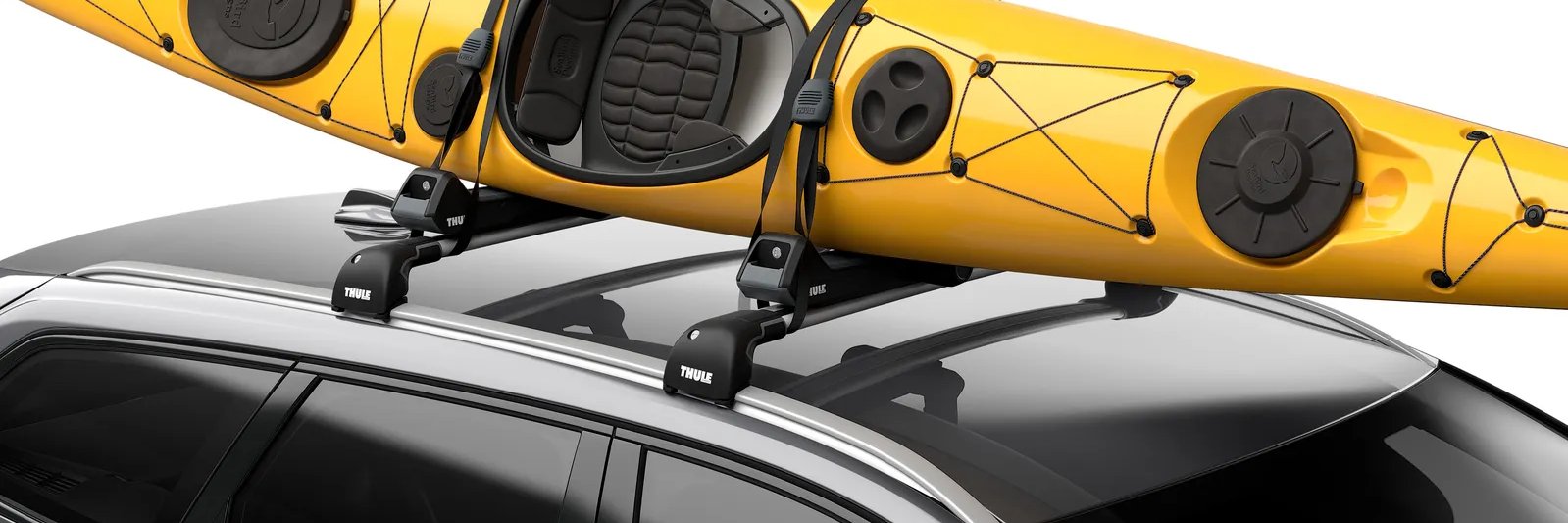
There are four common ways to carry a kayak.
- A J-style carrier holds the kayak upright on its side.
- Saddles cradle the hull flat, right way up.
- A stacker carries two or more kayaks on their sides, leaning against an upright post.
- Rubber pads on the bars work for a single kayak carried flat.
Each carrier has its own load limit, separate from the rack’s, and they vary. Thule’s Hull-a-Port Aero, for example, is rated for one kayak up to 34 kg, and Yakima’s JayLow for one kayak up to 45 kg. Check the figure for your carrier against your kayak’s weight.
Use bow and stern lines every time. These run from the front and back of the kayak down to the vehicle, and they stop it shifting or lifting at speed. Kayak carrier instructions call for them, and they’re cheap insurance on a long boat. If there’s nowhere to tie off at the front of your vehicle, anchor straps that sit under the bonnet do the job.
Carrier instructions also give a minimum distance between the bars, so set your bar spacing before you load.
SUPs and surfboards
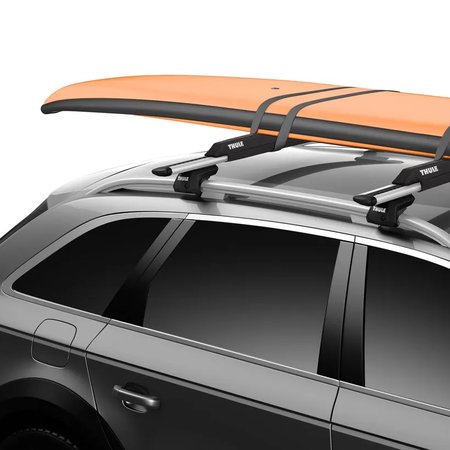
Boards usually go on padded bars or a board rack, deck down, with straps over the top.
Which way the board faces is less settled than you might expect. Guides differ on whether the fins go forward or back, and even one brand’s own instructions don’t agree, so follow the instructions for your carrier.
If you’re carrying more than one surfboard, stack them so the tail of each board sits between the fins of the one beneath it.
Go easy on the straps. Pull them too hard and they can crush the edge of a board. Tighten until the board can’t move side to side, and leave it there.
Check the straps again after the first few kilometres. Loads settle, and straps loosen as they do.
Straps that hum
A flat strap can vibrate at speed and set up a loud hum. A few twists in the strap between the board and the bar helps break up the vibration and the noise with it.
How far a load can stick out
Kayaks and SUPs are often longer than the vehicle carrying them, so the overhang rules are worth a look before you leave. Each state sets its own, but the National Transport Commission’s national Load Restraint Guide for light vehicles sets out the limits they share.
- Forward. No more than 1.2 m in front of the vehicle.
- Sideways. No more than 150 mm past either side.
- Rear. Measured from the centre of the rear axle, no more than 60% of the wheelbase or 3.7 m, whichever is less. Western Australia measures from the back of the vehicle instead, with a limit of 1.2 m.
If a load projects more than 1.2 m behind the vehicle, or is hard to see from the rear, it needs a brightly coloured flag on the end during the day and a red light at night. The flag and light rules differ in the detail from state to state, so check with your road authority. Queensland’s guide to projecting loads is one example.
Wind noise
Anything on the roof adds wind noise, and bar shape makes a difference. When Thule launched its WingBar in 2011, the company’s wind tunnel tests measured it at 13 dB quieter than the earlier AeroBar. That’s a maker testing its own product against an older one, but it shows how much the profile matters.
A wind fairing, a curved panel that mounts in front of the front bar, is designed to push air up and over the rack. How much it helps depends on the vehicle and the bars.
Fuel use
A rack and load make the vehicle work harder, and the cost shows up at the bowser. How much depends on the vehicle and what’s on top.
WhichCar ran a petrol Subaru Forester around a 100 km highway loop at 100 km/h three ways. With the bare roof and factory rails it used 6.46 L/100 km. With crossbars and a bike carrier fitted it used 7.06 L/100 km, and with two bikes loaded, 7.84 L/100 km. That’s one run of each, with bikes rather than boats, but it gives a sense of scale.
In the United States, Consumer Reports measured the effect at a steady 65 mph, about 105 km/h. A rack on its own cost a Nissan Altima almost 11% in fuel economy and a Toyota RAV4 nearly 2%. Adding a cargo box took that to 19% and 13%. Two ordinary cars, two very different results, and yours could land anywhere between them.
Take it off when you’re done
The simplest fix for noise and fuel is taking the rack off between trips. A modelling study by Lawrence Berkeley National Laboratory estimated that in the United States, empty racks left on cars accounted for more of the extra fuel use than loaded ones, simply because they spend so much more time on the road.
Carriers are listed under roof rack accessories and bars under crossbars. If you haven’t got a rack yet, start with our guide to what roof rack fits your car.